

Last time I wrote about lawn robots, I opened with “Robots coming through!” That was back in 2018 when we introduced Willie, a Husqvarna Automower we named because Willie Nelson means grass, which we thought was hilarious.
Well, spoiler alert: they’re still not good enough to use in most yards.
They have reached a point where they make sense on some commercial properties, golf courses, and sports fields. And they’re getting better every year. I spent last week exploring the latest models and talking with robotics experts. Here’s a quick download—with all the excitement, minus the hype.
First, A Little History: Meet Willie
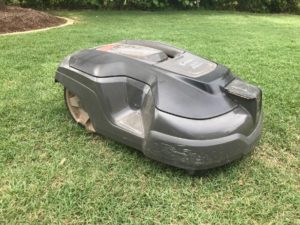
We got our first lawn robot in 2018. Willie actually kept the grass looking better than humans—not because he was smart, but because he mowed in very small increments all the time. That light, repetitive cutting is good for grass health and causes less soil compaction.
Plus, it was fun to watch.
Unfortunately, Willie got stuck constantly. He wasn’t smart. He needed a buried guide wire that broke all the time. He couldn’t edge. His software was limited. He could only handle one yard.
Today’s robots aren’t perfect, but they’re far more capable and a lot less frustrating.
What’s New in 2025—and Why It Matters
Let me generalize for a moment: it really depends on the model and manufacturer. That said, here are the major improvements showing up across the board:
1. Wire-Free Operation
A growing number of robots no longer need underground guide wires. That means:
- Faster and cleaner installation
- Fewer maintenance headaches
- Less chance of wires getting cut by accident
Big improvement.
2. Smarter Obstacle Detection
Some new models include cameras and sensors that help them avoid tree roots, flowerbeds, and furniture. Not all have cameras yet—but they’re getting cheaper and more common.
I’d say they get stuck about 5% as often as the old models, which makes them dramatically more useful.
3. Teamwork: Robot Swarms
This is where things start to get interesting.
Most homeowners or property managers don’t want to buy a $3,000+ robot mower. But landscaping contractors might, especially if it helps ease the labor shortage.
The key is using robot swarms—multiple robots that work together and move from property to property. Instead of leaving a mower on-site full-time (which is rarely practical), we’re starting to see companies use a fleet of robots they bring along to each job. They drop two robots here, four over there—each set programmed for that specific property.
One company trying this is Nexmow, and there are others emerging.
Of course, you still need a tech to edge, handle weeding, clear debris, and keep things tidy. But mowing? That’s starting to become more automated in select use cases.
A Word on Edging (and the Other Details)
Let’s be clear: robots can’t edge. Not even badly. They just don’t do it.
And they’re not solving the little things that make a yard look cared for:
- Trimming overgrown shrubs
- Pulling weeds from flower beds
- Fixing broken irrigation heads
- Blowing off the patio
In short: they help, but they don’t finish the job.
The Outlook: What’s Next?
Here’s what I think will happen:
- AI gets better, allowing robots to adapt to more complex yards.
- Manufacturing scales, which brings down costs.
- User interfaces improve, so contractors can use robots across diverse properties—not just cookie-cutter lawns.
- More companies adopt, which drives further innovation and lowers cost again.
It’s a cycle: better tools → more adoption → cheaper prices → better tools.
Don’t criticize me too hard on the economics—I didn’t major in this. But that’s the general trajectory.
Our Take
We’re watching robot mowers closely. They’re not ready for most of our customers—yet—but they’re getting close for certain types of properties.
When the time is right, we’ll use them:
- To keep costs low
- To let our team focus on higher-skill work
- And to serve customers better
But no, we’re not trying to install one in your backyard next week. We’re just keeping a sharp eye on the horizon—because that’s part of our job.